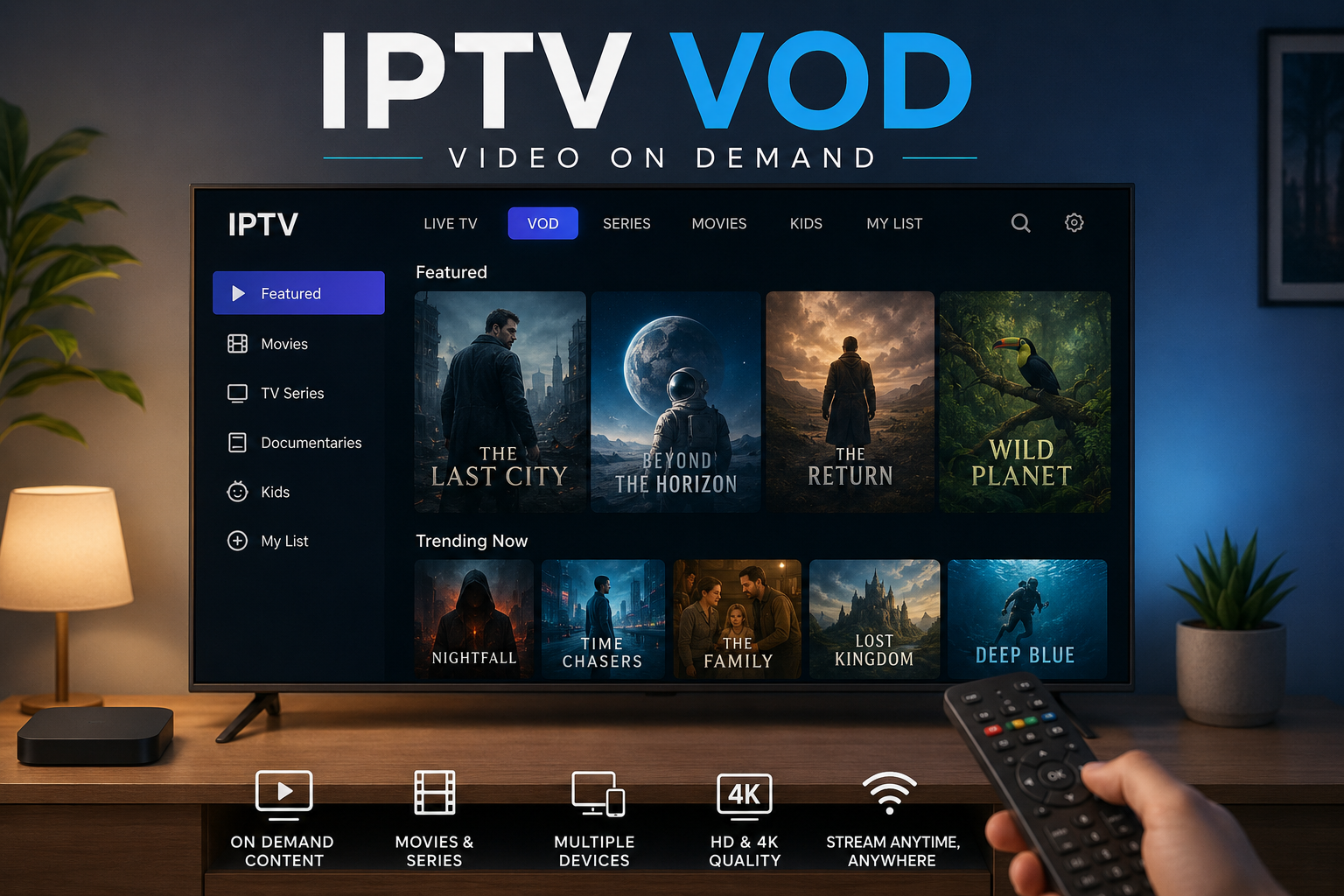
Video on demand has changed the way people watch television and online video. Instead of waiting for a programme to appear at a scheduled time, viewers can choose available content from a library and start watching when it suits them.
When this concept is delivered through an IPTV platform, it is commonly described as IPTV VOD or IPTV Video on Demand. Depending on the service, a VOD library may include movies, TV series, documentaries, catch-up programming, and archived content.
provides information about video-on-demand services, including catch-up services, online film services, and archive content.
This guide explains what IPTV VOD means, how it works, how it differs from live TV, which devices can support it, what affects video quality, and what users should consider before choosing a service.
What Is IPTV VOD?
IPTV VOD combines two concepts: IPTV and video on demand.
IPTV stands for Internet Protocol Television. It refers to delivering television or video content through IP-based networks rather than relying exclusively on traditional broadcast, cable, or satellite distribution.
VOD, meanwhile, means Video on Demand. It allows viewers to select available content and watch it when they choose instead of following a fixed broadcast schedule.
Together, IPTV and VOD create a viewing model where an IPTV platform can provide both live television and on-demand content.
This means an IPTV service may have different sections for live programming and a VOD library containing movies, series, documentaries, catch-up programmes, or archived content.
The important distinction is that IPTV describes the delivery technology, while VOD describes how the content is accessed.
How Does IPTV VOD Work?
The basic process is relatively simple:
Content → IPTV platform → Internet → App or device → Playback
First, content is stored or made available through a service with the appropriate distribution rights. The IPTV platform organises that content and makes it available to compatible applications or devices.
When a viewer selects a movie or programme, the device connects to the service through the internet and begins receiving the video data.
The application then processes the incoming data and displays the content on the user’s screen.
The actual experience can vary depending on several factors, including:
- Quality of the original video
- Service infrastructure
- Internet connection stability
- Device performance
- Application compatibility
- Screen resolution
Unlike a scheduled television broadcast, video on demand IPTV gives viewers more control over when to start the selected programme.
IPTV VOD vs Live TV
Although both can be delivered through IPTV technology, VOD and live TV provide different viewing experiences.
| Feature | IPTV VOD | Live TV |
|---|---|---|
| Viewing time | On demand | Scheduled or live |
| Content selection | User chooses content | Viewer follows a channel or programme schedule |
| Pause | Usually available | Depends on the service |
| Replay | Depends on the service | Depends on the service |
| Main experience | Select and watch | Watch what is currently being broadcast |
| Internet | Required for internet-based IPTV | Required for internet-based IPTV |
The main difference is control over viewing time.
With VOD on IPTV, a viewer can choose an available title and start watching when they want. With live TV, the programme follows a schedule, although some services also provide pause, replay, or catch-up functions.
What Can IPTV VOD Include?
An IPTV VOD library can contain different types of video content depending on the platform, region, and licensing arrangements.
Common categories include:
Movies
A VOD catalogue may provide films that users can select and watch individually.
TV Series
Some platforms organise episodes into seasons, allowing viewers to select individual episodes.
Documentaries
Documentary content can also be offered through on-demand libraries.
Catch-Up Content
Catch-up services allow viewers to watch eligible programmes after their original broadcast.
Archived Programming
Some services provide older programming through an archive-style library.
The exact content available depends on the service, region, licensing agreements, and rights held by the provider.
IPTV VOD and Video Quality
Video quality is another important part of the IPTV VOD experience.
Common quality levels include:
- SD: Standard Definition
- HD: High Definition
- Full HD: 1920 × 1080 resolution
- 4K: Ultra High Definition, typically 3840 × 2160 resolution
However, a service advertising 4K capability does not automatically mean every title will play in 4K.
Actual quality can depend on the source file, available bandwidth, device capabilities, display resolution, application, and service infrastructure.
For example, a 4K-compatible television cannot turn an SD source into genuine native 4K content. The source itself must provide the appropriate quality.
Internet Requirements for IPTV VOD
A stable internet connection is important for internet-based VOD because video playback continuously transfers data between the service and the viewing device.
Higher video resolutions generally require more bandwidth than lower resolutions. Watching on several devices simultaneously can also increase overall network demand.
For a deeper explanation of connection requirements, see our Internet Speed for IPTV guide.
Internet speed is not the only factor, however. Connection stability, Wi-Fi performance, network congestion, router performance, and the distance between the device and router can also influence playback.
A fast connection that frequently drops or becomes unstable may still result in buffering.
IPTV VOD on Different Devices
One advantage of modern internet video services is that they can work across a variety of connected devices.
Depending on the service and application, IPTV VOD may be available on:
- Smart TVs
- Android TV devices
- Streaming devices
- PCs and laptops
- Smartphones
- Tablets
Compatibility depends on the application and the operating system supported by the service.
Before choosing an IPTV VOD service, users should check whether the application works with their particular device rather than assuming that every IPTV application supports every platform.
If you want to learn more about IPTV on computers, see our IPTV on PC guide.
IPTV VOD on Smart TVs
Smart TVs are among the most convenient devices for watching VOD because they can provide direct access to applications without requiring a separate computer.
However, several factors should be considered.
App Compatibility
The application needs to be compatible with the television’s operating system.
Operating System
Different Smart TV platforms may support different applications and versions.
Screen Resolution
A 4K television can display high-resolution content, but the source and application must also support that quality.
Device Performance
Older Smart TVs may have less processing power or limited application support compared with newer models.
Application Availability
Not every IPTV VOD application is available on every Smart TV platform.
For additional information about Smart TV compatibility, see our IPTV for Smart TV UK guide.
IPTV VOD vs Traditional Video on Demand
IPTV VOD and other internet-based VOD services share the same basic concept: users select video content and watch it when they choose.
The difference is often in the platform and overall service structure.
A traditional VOD service may focus primarily on an on-demand catalogue, while an IPTV platform can combine different types of television and video delivery, including live programming and VOD.
The device used to access VOD can also vary. Connected televisions, mobile applications, computers, and set-top boxes can all provide access to different VOD services.
Therefore, the term IPTV VOD service describes a VOD experience delivered as part of an IPTV environment rather than a completely separate type of video technology.
Subscription VOD vs Transactional VOD
Not all VOD services use the same payment model.
Two common models are SVOD and TVOD.
What Is SVOD?
SVOD stands for Subscription Video on Demand.
Users pay a recurring subscription fee to access a library of available content.
Access generally continues while the subscription remains active, although the catalogue can change over time.
What Is TVOD?
TVOD stands for Transactional Video on Demand.
Instead of paying for broad access to a library, the viewer pays for individual pieces of content.
This may involve renting a movie for a limited period or purchasing specific content.
| Model | How It Works |
|---|---|
| SVOD | Recurring subscription provides access to a library |
| TVOD | User pays for individual content |
| Hybrid | Service may combine different payment or access models |
Understanding the payment model can help users compare VOD services more accurately.
What to Check Before Choosing an IPTV VOD Service
If you are comparing an IPTV VOD service, look beyond the size of its content library.
1. Device Compatibility
Check whether the service and application support your Smart TV, streaming device, computer, phone, or tablet.
2. Video Quality
Look for clear information about supported resolutions rather than assuming that all content is available in HD or 4K.
3. Reliability
A good VOD experience requires consistent playback and dependable service infrastructure.
4. Internet Requirements
Understand the recommended connection requirements and consider how many devices will use your network simultaneously.
5. Privacy and Security
Review the provider’s privacy policy and understand how account and personal information is handled.
6. Pricing Transparency
The price should be clearly presented, including any recurring charges or additional fees.
7. Cancellation Terms
Before subscribing, check how cancellation works and whether subscriptions automatically renew.
8. Content Authorization
A legitimate service should be transparent about the rights and licences associated with the content it provides.
Content Rights and Legality
It is important to distinguish the technology from the content and service using that technology.
IPTV and VOD are technologies and delivery models. Their legality is not determined simply by the fact that content is delivered over an IP network.
What matters is whether the service has the necessary rights to provide the content to viewers.
In the UK, certain video-on-demand services fall within Ofcom’s regulatory framework and may have specific notification and regulatory obligations.
For this reason, users should avoid services that are unclear about where their content comes from or whether they have permission to distribute it.
Choosing a transparent service with clear terms, identifiable business information, and appropriate content authorization is a more responsible approach.
Common IPTV VOD Problems
Even legitimate VOD services can experience technical problems.
Buffering
Buffering may result from an unstable connection, network congestion, insufficient bandwidth, or problems on the service side.
Low Video Quality
Quality can be affected by the original source, network conditions, device limitations, or automatic quality adjustment.
App Compatibility
An application may not support every Smart TV or operating system.
Expired Content
VOD catalogues can change when licensing agreements expire or content rights change.
Connection Problems
Wi-Fi interference, router issues, or temporary internet problems can interrupt playback.
Device Limitations
Older devices may have limited processing power, application support, or video-decoding capabilities.
Understanding these possible issues makes it easier to identify whether a problem comes from the internet connection, device, application, or service itself.
Frequently Asked Questions About IPTV VOD
What is IPTV VOD?
IPTV VOD means video-on-demand content delivered through an IPTV environment. It allows users to select available movies, series, documentaries, or other programmes and watch them when they choose.
What does VOD mean in IPTV?
VOD means Video on Demand. In IPTV, it refers to content that viewers can select and play instead of watching according to a fixed live-TV schedule.
Is IPTV VOD the same as live TV?
No. Live TV follows a live or scheduled broadcast, while VOD allows viewers to choose available content and start watching it at a convenient time.
Can IPTV VOD work on Smart TV?
Yes, IPTV VOD can work on compatible Smart TVs when the required application and operating system are supported.
Does IPTV VOD require internet?
Internet-based IPTV VOD normally requires an internet connection because the video is delivered through an IP network.
Does IPTV VOD support 4K?
Some IPTV VOD services and content can support 4K, but actual resolution depends on the source, service, application, device, display, and available network performance.
What is the difference between SVOD and TVOD?
SVOD provides access to a VOD library through a subscription, while TVOD allows users to pay for individual pieces of content, such as a rental or purchase.
Final Thoughts
IPTV VOD provides a flexible way to access video content without being tied to a traditional broadcast schedule. By combining IPTV delivery with on-demand viewing, users can select available movies, series, documentaries, catch-up programmes, and other content when they want to watch.
However, the quality of the experience depends on more than simply having an IPTV application. Device compatibility, internet stability, video source quality, service reliability, pricing transparency, privacy, and content rights all matter.
When comparing an IPTV VOD service, focus on these practical factors rather than relying only on claims about the size of a content library or supported resolution.
For more IPTV guides and information about internet-based television, visit Digitalwebb01.