
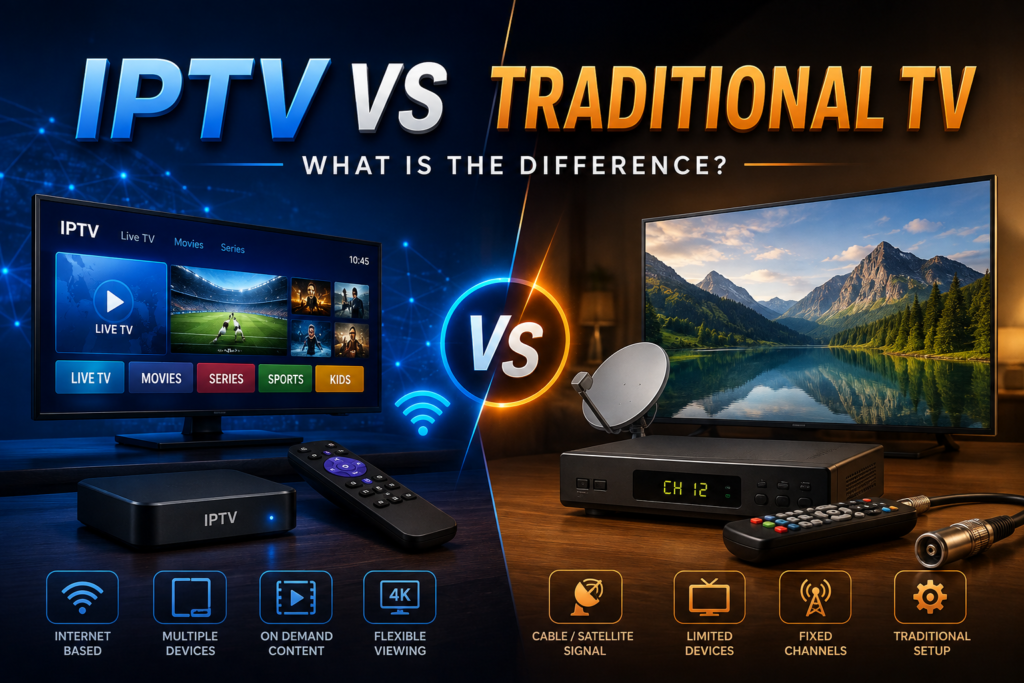
Television has changed significantly over the last few years. Traditional cable and satellite services are no longer the only ways people can access television content, with internet-connected TVs and streaming platforms becoming increasingly common.
One technology often discussed in this changing television landscape is IPTV, or Internet Protocol Television.
But what is the difference between IPTV and traditional TV? How does each option deliver content, what devices can be used, and what should viewers consider when choosing between them?
This guide explains the main differences in a simple way.
What Is IPTV?
IPTV stands for Internet Protocol Television. It refers to television content delivered through IP-based networks.
Ofcom explains that Smart TVs can access television channels delivered through the internet, commonly referred to as IPTV or Internet Protocol Television.
Unlike traditional television delivery, which can use terrestrial broadcasting, cable, or satellite, IPTV relies on network connectivity to deliver content to compatible devices.
The exact experience depends on the particular service, application, device, and network.
What Is Traditional TV?
Traditional television generally refers to established methods of delivering television programming, including:
- Terrestrial television
- Cable television
- Satellite television
These systems use dedicated broadcasting or distribution infrastructure to deliver television signals to viewers.
For example, terrestrial television uses broadcast transmitters, while satellite television relies on satellites and receiving equipment.
Cable television uses a cable network to deliver television services to connected homes.
IPTV vs Traditional TV: The Main Difference
The biggest difference is how the television content reaches the viewer.
Traditional television generally relies on broadcasting or dedicated distribution networks.
IPTV uses IP-based networks to deliver content.
This difference can affect the equipment required, the way services are accessed, and the types of devices that can be used.
Modern connected devices have also made internet-based television increasingly accessible. Ofcom notes that connected TV platforms are becoming important gateways through which UK audiences access digital content and services.
How IPTV Works
When using an IPTV service, video content is transmitted through an IP network to a compatible device.
A simplified process looks like this:
- Content is prepared for digital delivery.
- The content is transmitted through an IP network.
- The user’s device receives the data.
- A compatible application or platform processes the stream.
- The content appears on the viewer’s screen.
The exact technology behind different services can vary.
The quality of the final experience can also depend on network conditions, device performance, application design, and the source of the content.
How Traditional TV Works
Traditional television uses different transmission methods.
Terrestrial TV
Terrestrial television uses radio-frequency signals transmitted from broadcast infrastructure to receiving equipment.
Satellite TV
Satellite services transmit television signals through satellites. Viewers generally need appropriate receiving equipment to access these services.
Cable TV
Cable television uses physical cable networks to deliver television services to customers.
Each method has its own infrastructure and technical characteristics.
IPTV and Smart TVs
Smart TVs have helped bridge the gap between traditional television and internet-based entertainment.
Modern Smart TVs can connect directly to the internet and provide access to different applications and online services.
Ofcom notes that connected TV platforms are becoming increasingly important for how UK viewers discover and access content.
If you’re interested in learning how IPTV-related services can be configured on compatible devices, our IPTV Setup Guide provides additional information.
IPTV on Different Devices
One advantage of internet-based television is that compatible services may work across different types of connected devices.
Depending on the application and service, these can include:
- Smart TVs
- Android TV devices
- Fire TV devices
- Apple TV
- Smartphones
- Tablets
- Windows computers
- Mac computers
However, compatibility varies. An application available on one platform may not be available on another.
For this reason, viewers should always check the current requirements of a service before subscribing or installing an application.
IPTV vs Cable TV
Cable television has traditionally been delivered through a physical cable network.
IPTV uses IP-based network infrastructure.
Cable can provide a dedicated delivery network, while internet-based television can take advantage of connected devices and internet services.
The best choice depends on the provider, available infrastructure, content, pricing, device requirements, and the viewer’s preferences.
IPTV vs Satellite TV
Satellite television uses satellite transmission to deliver television signals to receiving equipment.
IPTV instead relies on IP network connectivity.
Satellite television can be useful in locations where terrestrial or cable services are limited, while IPTV can be convenient for viewers who already have reliable broadband and compatible connected devices.
Neither technology is automatically better for everyone.
Streaming Quality
Picture quality is another important consideration.
Modern television services can provide different resolutions, including HD, Full HD, and 4K.
With internet-based television, the final viewing quality can be influenced by:
- Internet connection
- Network stability
- Device capabilities
- Video source
- Application performance
- Network congestion
A 4K television alone does not guarantee 4K playback. The content source and complete streaming setup also need to support the desired resolution.
Internet Requirements
One of the most important differences between internet-based television and traditional broadcasting is the role of the user’s internet connection.
IPTV and other internet-delivered services depend on network connectivity.
A viewer may have a fast broadband package but still experience problems because of weak Wi-Fi, congestion, router issues, or other network conditions.
This makes network performance an important consideration when evaluating internet-based television.
Device Flexibility
Traditional television often depends on specific receiving equipment.
Internet-based services can potentially provide access through multiple connected devices.
For example, a viewer might use a Smart TV at home and a compatible mobile device elsewhere.
However, this flexibility depends on the specific service and its terms.
If you’re interested in mobile viewing, you can also explore our guide to IPTV on iPhone.
IPTV and Subscription Models
Digitalweb IPTV streaming service
Traditional TV packages may bundle channels and services together.
Internet-based services can use different subscription models depending on the provider.
Before subscribing to any service, viewers should carefully check:
- Price
- Subscription duration
- Renewal terms
- Cancellation conditions
- Refund policy
- Device compatibility
- Content availability
Understanding the terms before purchasing can help avoid unexpected costs.
Content Availability
Content availability can differ considerably between services.
Traditional television providers may offer established channel packages, while internet-based services can provide different combinations of live and on-demand programming.
The important point is to check what is actually included rather than relying solely on advertising claims.
Viewers should also ensure that a provider has appropriate authorization to distribute the content it offers.
The UK government has published guidance warning consumers about illicit streaming and unauthorized access to copyrighted content.
Is IPTV Legal?
IPTV as a technology is not inherently illegal.
The important issue is how a particular service uses the technology and whether it has the necessary rights to distribute the content it provides.
Consumers should therefore research providers carefully and choose services that legitimately distribute their programming.
The UK government’s guidance specifically distinguishes legitimate uses of streaming technology from services that provide copyrighted content without permission.
Which Is Better: IPTV or Traditional TV?
There isn’t one answer that applies to everyone.
IPTV may appeal to viewers who prefer internet-connected devices and flexible access to digital services.
Traditional television may appeal to viewers who prefer established cable, satellite, or terrestrial delivery methods.
The best option depends on factors such as:
- Internet availability
- Device preferences
- Content requirements
- Budget
- Picture quality
- Service reliability
- Subscription terms
Rather than choosing based on technology alone, compare the actual services available to you.
What Should You Consider Before Choosing?
Whether you’re considering IPTV or traditional television, ask yourself a few basic questions.
What do you watch most?
Choose a service that provides the content you actually want.
What devices do you use?
Make sure the service works with your Smart TV, streaming device, smartphone, or computer.
How reliable is your internet?
If you choose an internet-based service, a stable connection is important.
What are the subscription terms?
Check the price, renewal conditions, cancellation policy, and refund terms.
Is the content properly authorised?
Choose providers that can legitimately distribute the programming they offer.
IPTV vs Traditional TV: Quick Comparison
| Feature | IPTV | Traditional TV |
|---|---|---|
| Delivery | IP networks | Terrestrial, cable or satellite |
| Internet required | Generally yes | Not always |
| Smart devices | Often supported | Depends on provider |
| Mobile access | May be available | Usually more limited |
| 4K availability | Service dependent | Service dependent |
| Setup | Device/application dependent | Equipment dependent |
| Content | Depends on provider | Depends on provider |
| Subscription | Service dependent | Service dependent |
Final Thoughts
The difference between IPTV and traditional TV mainly comes down to how content is delivered.
Traditional television uses established broadcasting, cable, or satellite infrastructure, while IPTV delivers television through IP-based networks.
Modern connected TVs have made the distinction less noticeable for many viewers because a single television can now combine traditional broadcast channels with internet-based services.
The right choice ultimately depends on your internet connection, preferred devices, content requirements, budget, and the services available in your area.
If you want to learn more about IPTV technology and setup, explore the Digitalwebb01 IPTV Setup Guide and our other IPTV resources.